Showing posts sorted by relevance for query Medusa. Sort by date Show all posts

Saturday, January 01, 2005


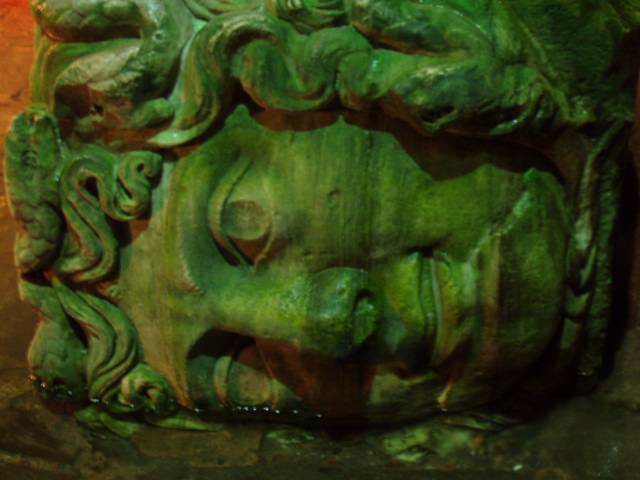
Medusa head at bottom of column, Istanbul, Turkey Posted by Hello

ARTIFACT OF THE DAY. This stone head at the base of a Roman column can be found in the innermost deepest part of a small waterworks museum in Istanbul, near the Haga Sofia and hippodrome. The museum allows visitors to wander a series of boardwalks around an underground water works from Roman times; I took these pictures while on sabbatical there in March 2004.

Medusa, one of the three Gorgon sisters, with snakes intwined in her hair, commonly appeared on such columns at important buildings in ancient Greece and Rome. Originally, Medusa was a very beautiful woman who fell in love with Perseus. Mythology tells us that Athena became jealous of Medusa, and transformed her so that anyone who looked at Medusa would turn to stone (a feminist would ask: Is this the appropriate end for female beauty, a target of jealousy?). Even so, Perseus eventually killed Medusa, beheading her, thus ending her hypnotic power. Yet, the image of Medusa also appears frequently on Roman armour and shields, offering protection in battle. And statues of Perseus killing Medusa appear again and again.

Here, in this small museum, what's fascinating is that the column is turned upside down, as if to deliberately end the power of Medusa, yet in some way, continue her protection, as her face is not defaced or destroyed. Stephen Harris and Gloria Platzner, in their book Classical Mythology, point out the conflict between matriarchal and patriarchal belief systems (pages 123+):

"As long as death is perceived as part of the ongoing cycle of life, death, and rebirth, the Goddess's serpent is portrayed as a beneficent creature. Once the patriarchal perspective takes hold, however, death becomes the final blow to the hero's ego, and the Goddess's Underworld functions come to seem terrifying. The once beautiful serpent is now transformed into the hero's perpetual enemy, the dragon."

Harris and Platzner go on to refer specifically to the Greek Gorgon sisters (Stheno, Euryale and Medusa), showing a Gorgon from a marble relief at a temple of Artemis at Corfu (6th Century BCE), "whose bulging eyes, protruding tongue, and hair of snakes, along with her belt of entwined snakes, render her a truly hideous figure" (123). Since the snake is such an important symbol to east and west, how interesting this symbol is converted from a sign of power and protection to a female mask that one must destroy out of revulsion.

See the Gorgon pediment (west facade of the Doric Temple of Artemis) at the Archaeological Museum of Corfu at http://www.culture.gr/2/21/211/21108m/e211hm01.html

Wednesday, March 31, 2004

The last week has been hectic. Just after our good friend, Pam, left for home ın Salem, Oregon, after an intense tour of Southern Turkey, including sunny and warm Antalya, our friends Jamie and Henry (from Oregon) and Lynda and Gordon (from Philadelphia) came in to join us as we toured Pergamon, Ephesus, and left Turkey via the Mediterranean to Rhodes and Crete. After three hectic days in İstabul, visiting the highlights, we ventured forth on a 10-hour bus ride, which included two ferry boat rides, the second ride had our entire bus go on the ferry for a 45 minute ride. Finally, we arrived ın Pergama, close to the famous ruins.

We spent yesterday climbing around the Acropolis at the top of a high hill near Pergama. Visualize typical Roman ruins, tall columns topped wıth Corinthian capıtals, an agora (open marketplace), and several levels of major temples, gymnasia, public baths, and a theater that held 30,000 people at one time. İ'm having a hard time describing the scope of what we saw. Every direction we looked, we could see sweeping vistas of the valley below. Ancient Pergamon was eminently defensible. İ cannot imagine how Rome fell with such beautiful, cosmopolitan, and easy-to-defend cities -- except for the pride of militarism.

The scope is very grand in time as well as space, covering some 275 meters, with ruins from about 300 BCE to about 300 present time. We spent about four hours there, then hiked all the way down the mountain through town, to a museum and lunch, then returned to the hotel to find a family emergency awaited Gordon and Lynda that precipitated their immediate return to Phıladelphia. Many long distance calls later, Gordon and Lynda were safely on their way.

Today, we felt a bit at odds, all of us far from home and worried about friends. We went out later in the morning to the last ruins in Pergama, the Asclepion or one of the three most famous healing centers in the ancient world. Used as a healing site since about the 4th Century BC, and located on a low hill (not militarily defensible), this site has been burnt and destroyed and then rebuilt many tımes until about 400 AD. At first the site was not too spectacular, compared to the Acropolis of yesterday, but then we began to explore, with maps in hand. Here, gladiators were brought for healing. Healing was also seen as part of a spiritual journey, wıth sleeping rooms for patients so their dreams could be told to the healer-priests. We walked through the baths, the stately columns, some topped wıth Doric, some topped with Corinthian capitals. Destroyed by earthquakes, these columns have since been placed on pediments of different sizes by Roman architects to keep the line at the top of the column the same. Our favorite here was the sacred tunnel which runs entirely under the ground ın the very large open courtyard. Natural light and the sound of water running, even until today, creates a harmonius experience -- one, you might say, is conducive to healing! We sat for a long time in the theater for patients (only seating for 3,500), enjoying the sunshine and hoping Gordon and Lynda arrived safely ın Philadelpia. Then sunburned and tired, we headed back to our hotel, finally stoppıng at the local İnternet cafe to check for e-mails.

Such a sense of history still surrounds this town, despite elections now completed (no political flags in the streets, no passing vans blaring catchy music). As we head south to Ephesus, we plan to read more about the Romans and prepare for Rhodes, the home of the Mınoans. İ dıd learn that Medusa was highly valued here, with her hair of snakes, for the snake was seen as the symbol of healing -- the skin of the snake falling away to new skin.

Yes, İ was able to post some new pictures -- so if you want to see some more slides of Turkey and especially Capaddocia, please go to http://community.webshots.com/user/beth_home

ALERT: Finally, that link on the RİGHT HAND side of the screen to my photos at webshots works. Give it a try!

İ also can recommend LORDS OF THE HORIZON for a good read on Ottoman history. And İ wısh you all a warm and gentle spring.

Beth

bluebethley@yahoo.com

Wednesday, March 10, 2004

This morning, we headed deep down into a basilica cistern built by Justinian. İt was cold and dripping wet, but with hundreds of columns, scavenged from everywhere -- a mixture of all styles of Greek columns, doric, corinthian, and ionic, some upside down, some cut in half and patched back together. The real draw, though, was at the deepest part of the cistern where underneath the bottom of a column rested the monumental stone head of Medusa, one of the Gıant Gorgon sisters, the pretty one who fell in love with Perseus and had her lovely black haır turned ınto a snake-do that turned all who looked at her into stone. Why are these tales told of women?

Yesterday, we toured the gigantıc mosque built by Sulıeman ın the 1500s and then visited the smaller mosque created for the Grand Viziıer by Sinan, the great Ottoman architect. Both mosques were overpowering, but in different ways. At the larger mosque, the caretaker took us around, even close to the mihrab where we weren't supposed to go. He wanted us to see everything despite the language barrier. Before we left, he annointed us wıth rose oıl, a sweet smellıng perfume, a sign of traditional Turkish hospitality. At the smaller mosque, we were dazzled wıth İznik tiles everywhere on the walls, columns and ceilıngs -- brilliant blues and reds and greens. Each wall featured a different design, all wıth the meandering flower motıf -- yet ındıvıdually painted, made in the 16th Century and still so bright. Here too we saw a small chip of the Ka'aba from Mecca, mounted over the door. We also walked through the Spice Bazaar and discovered Turkish Delights. I think our west coast aplets and cotlets are inspıred by this traditıon.

Our three day trip to Ankara was not without excitement -- but we spent hours at the Anatolian Museum of Ancıent Civilizations whıch featured many goddess artifacts, breathtaking. We noticed some that were Cycladic, greatly treasured as they appeared as grave goods ın Central Anatolia. Another highlıght here was walkıng around Ankara ın a snow storm -- hiking up the hill to the Citadel, a quasi-restored Turkish village where we ate traditional foods prepared ın a 'sitting' style kıtchen. You can see these ın the Webshots photo album of Turkish pictures, as İ finally was able to post some pictures -- though uploading pics ıs VERY SLOW. Everyone has been welcoming. The sun has been shining -- ıt's just raining a little today.

We finally found some books on Ottoman history. Books here in Turkey are very expensive, even paperbacks, and there are very few used book stores. No Book Bin ın İstanbul.

İ'm feelıng a little guilty as İ know it's nearing finals week back home, and here İ am, gettıng lots of sleep, reading, writing, studying, and truly having the most amazing tıme. Our first visitor from home comes tomorrow and we can't wait to show off Istanbul and head down the coast to the ancient ruins of Cappadoccia. Of course, first we'll stop off at our favorite restaurant, the Cafe Magnaura, which features Amerıcan blues and truly great Turkish cuisine. İ plan a Turkish feast when we're home.

Good thoughts to all as winter moves so slowly to spring.

Beth

bluebethley@yahoo.com