Saturday, June 11, 2005


Roman mosaic found in Turkey telling story of the birth of the Minotaur and Daedalus' design of the labyrinth. The interesting story of this mosaic is that NOVA writes it up with an emphasis on Daedalus and Icarus, even to the title of this mosaic. Here's NOVA's summary.

"When King Minos of Crete [center] decided to keep alive a magnificent bull that Poseidon had given him for sacrifice, the sea god punished him by having Minos's wife Pasiphae (seated at left in the mosaic) fall in love with the bull. To satisfy her desire, the architect Daedalus and his son Icarus (second from right and far right, respectively) built her a hollow cow in which she could hide and mate with the bull. Their coupling produced the half-man, half-bull Minotaur, which was shut away in the maze-like Labyrinth (upper right)."

The female figure between King Minos and Pasiphae remains a mystery. The central figure remains King Minos, linked to his wife on the left, yet reaching out to Daedalus on the right. Pasiphae is shown seated, looking somewhat self-satisfied, self-absorbed. Researchers speculate that the laybrinth, shown on the far right as a separate building, is actually the entire palace complex at Minos on Knossos for its hundreds of connecting rooms and hallways. What is the moral of this story: To disobey the gods brings horrific retribution? That our desires or curiosity cannot always be satisfied? That we cannot always confront what we create -- with human technology? How interesting that this particular scene, massive in size, was chosen for the floor of this Roman villa in Turkey. Which characters shown drawn your sympathy? I'm curious about that woman in the middle. Is she a servant? A messenger? A goddess herself? Is she perhaps the storyteller herself (see the outstretched hand), or is she the mistress of the house in which this mosaic was found?

Source of story and mosaic: http://www.pbs.org/wgbh/nova/zeugma/mosa_05.html#fea_top Posted by Hello
Saturday morning, early. Spring term is finally over! Whew! What a rush at the end with last-minute papers, a mix of celebration and completion for most. This morning up far too early but Allen called me in to see a few minutes of NOVA's breathtaking story about the Roman mosaics found in Turkey. 10 mosaics were discovered just before (or perhaps because of) a new dam that would drench this historic area with a new lake. The expressiveness of these mosaics, the brilliance of their colors -- and the really fine recreation of a Roman villa in the Hellenistic period make this site one to visit: http://www.pbs.org/wgbh/nova/zeugma/
And now that summer's begun, it's time to blog once more. So, into the breach, blog!

Sunday, May 15, 2005


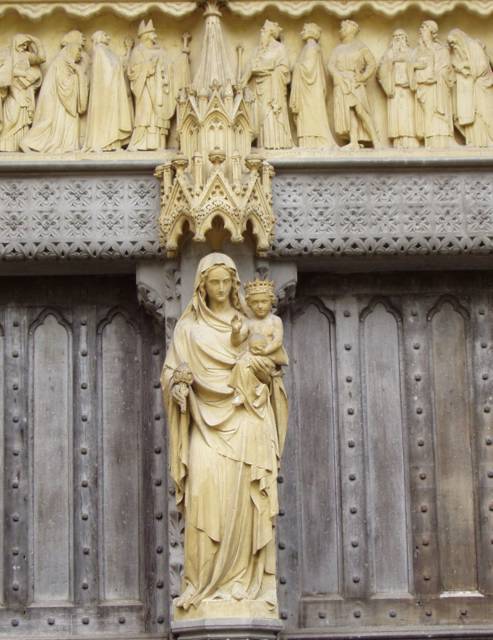
Virgin with Christ child and Jerusalem crown, Westminster Abbey, London, July 2004. Posted by Hello On Friday, in a rather large and impersonal classroom, I gave the slide-show on Israel at school. I was concerned before hand and felt even after, the overall talk didn't say everything I wanted. So here's a place to put the ideas down. Part of the problem is that religion is involved. Who could consider traveling to Israel and not be drawn to the topic of religion and Jerusalem? So, writing my ideas down will help me crystalize my thinking -- even if there's no time, not enough time for this kind of writing.

Why begin with a sculpture outside Westminster Abbey in London, when I want to talk about Jerusalem? The statue is conventional and beautiful, with a curious city floating above her head. I found this city-crown floating over hundreds of church sculptures -- saints and the virgin. Finally, in an orientation by a man who studied church architecture his entire life, finally, at Chartres Cathedral, in France, I learned the mystery behind these curious city-crowns. They represent Jerusalem and the longing of the Christian medieval world to reclaim the birthplace of Jesus from the Muslims.

For at this time, just after the turning of the millenium, powerful religious, economic and political factors fused to bring the Western Christian world in a series of brutal Crusades against the Muslim world, which at that time dominated the lands around the Mediterranean Sea, from eastern Turkey, through Palestine, Egypt, across northern Africa and up to well over half of Spain. People from every class joined the Crusades over a 200 year period, in five separate waves, the First Crusade called by Pope Innocent III, not to convert lost souls to Christianity, but to reclaim the heart of Christianity -- Jerusalem.

We cannot understand Jerusalem and the current state of Israel without understanding the history of enmity that permeates her culture.

My talk explored the story of Masada, and then returned to Jerusalem to look at three sacred spots: the Wailing Wall, sacred to Jews as a tangible reminder and place to mourn the loss of the Second Temple, which was destroyed in the year 70, and itself represented the rebuilding of King Solomon's First Temple that held the Ark of the Covenant; the Church of the Holy Sepulchure, built originally by St. Helena, sister to Emperor Constantine, in 345, and sacred to Christians as the church that marks the crucifixion of Christ (five Stations of the Cross are placed inside this church); and the Dome of the Rock, sacred to Muslims, for that golden-domed mosque built in 691 was placed where Mohammed left for his Night Journey, his footprint embedded in the Foundation Stone which rests at the center of the mosque. And yet enmity and the potential for violence permeate the culture of Jerusalem, despite the confluence of these three major religions.

Part 1 (next time) Masada. Please leave a comment if you like; I think they're working now. Beth

Tuesday, April 19, 2005

Saturday's visit to the University of Oregon's newly refurbished museum found me fascinated by two artists -- Kiki Smith and Rick Barstow. I cannot remember what the docent said about Kiki Smith's The Blue Lake because the image was so compelling. I was drawn immediately into the ferocious gaze of the main figure, the distortions, the compelling sense the brown hair was the earth and the woman herself, her body was the lake. Was the painting a mediatation inward, blue the color chosen to remind us of death, of drowning?

The second artist, Rick Barstow, had intrigued me on my first visit because the painting was so dramatic, a deer (?) head affixed to a male torso, intense colors, no arms, helpless but why? Echoes of the Green Man myth perhaps? The docent added that not only was Barstow a Native American artist, but that he was a Vietnam vet. Transformations. Uniquely male view.

Immediately I jumped to the net to explore more of both of these artists. Kiki Smith is already well established, showing at MOMA in New York, but Rick Barstow also has a New York presence in SoHo. I haven't had time to write about what I learned, but I appreciate being able to see more than one work by these two artists, for their interests, ideas and creativity are inspirational, challenging, and compelling.

Kiki Smith at MOMA: http://www.moma.org/exhibitions/2003/kikismith/
Exhibits: http://www.artseensoho.com/Art/PACE/smith97/smith1.html and http://www.varoregistry.com/smith/

Rick Barstow art and statement on being a Native American artist http://members.aye.net/~kacf/Bartow.html NPR Interview http://www.npr.org/programs/talkingplants/features/2003/bartow/
A Time of Visions: http://www.britesites.com/native_artist_interviews/
Barstow at the Froelick Gallery, Portland OR http://www.froelickgallery.com/Artist-Detail.cfm?ArtistsID=227
Interview at: http://www.jca-online.com/ksmith.html

Tuesday, April 05, 2005

It's Tuesday morning. Help! I need a reminder as to why I should like Lord Byron. I know he's considered a great Romantic poet and is revered by the Greeks for his support of their drive to nationalism, but I see his life glorified, and I just get mad.

Here's a man who created himself, not a bad feat. Born with a club foot and overweight, teased dreadfully as he was growing up, he retired to his estate, lived on crackers and water, and then surrounded himself with a coterie of freinds who gathered at wild parties, complete with dancing girls and drinking wine from a skull's head.

When his early poems were published, he became the darling of society. Women were drawn to his beauty and his passion (as well as his nobility), and it didn't matter to him that they might be married or innocent. In fact, he considered women an ornament -- women should not eat in public, he said, it mars their beauty. His liaisons contributed to his death as well; hailed as a hero for going to Greece in a time of their war for independence, he was caught in a rain storm while travelling to be with his married lover, caught a severe cold and died.

Some of the lines of his poems echo in my heart. When I was younger, I idolized him. Today, I see the context of his life and realize how many men patterned their behavior and attitudes toward women after him. So I take it nearly as a personal affront.

Fiero's treatment of Byron is far too sympathetic. She says he was
"alienated from society" (35) and that he was fascinated by the myth of Prometheus "as a symbol of triumphant individualism". My point is he made choices; Prometheus acted for the good of humanity, stealing fire/knowledge from the gods. But Byron's fire is passion without integrity. I have the feeling I'm not being fair. Give me a reason to care again about Byron. Beth

Source: Gloria K. Fiero, The Humanistic Tradition, Vol 5: Romanticism, Realism and the 19th Century World. McGraw-Hill, 2002.

Thursday, February 10, 2005

So, the challenge of today to talk about plagiarism and scholarly integrity! Ha! I feel like Don Quixote tilting. The ease of access to so many fine ideas provides much temptation to my students who copy and paste with abandon -- and then freewrite. So, today, using the fantastic paintings of Hieronymous Bosch and the crackpot theory that a viewer can possibly tell if a Catholic Reformation or Protestant rebellion is coded in these 15th and 16th Century paintings, we shall explore the issues of plagiarism. More later!

Monday, February 07, 2005


Detail of wall hangings, Street of the Tentmakers, Cairo, Egypt.

Tonight I'm feeling just a little recovered from the awful cold that's going around and getting ready to read a set of papers. First, what are these wall hangings? These hand-sewn applique quilted hangings, roughly 3 x 4 feet, are crafted in small open-air shops along the Street of the Tentmakers in Old Cairo.

Here, in the space of a roughly 8 x 10 workspace/shop, 2 or 3 teenaged boys will sit cross-legged, under the eye of the shop manager, and spend their day stitching traditional Islamic designs backed with canvas. Once the tentmakers along this street served the carvans along the famed Silk Road with colorful tents; today, some shops specialized in larger, brilliantly colored, sheet-sized quilts to decorate weddings, restaurants, or a butcher's shop.

The Street of the Tentmakers is just far enough away from tourist tours to be quiet, yet the workmanship is exquisite. The young men were pleased to have their work praised; I knew from the high unemployment rates that they were also pleased to have a job, for we often met cabdrivers with university degrees. We were able to bring just one small hanging home to treasure.

The traditional Islamic designs carry more meaning than I've been able to decipher. I can see the repetition, the geometric "frame and meander" that is traditional. Almashriq's article says the designs come from the mosaic floors in medieval mosques, where design is not left to chance.

For more historical background and more detailed pictures, see this site: http://almashriq.hiof.no/egypt/600/670/677/cairo_tentmakers/
For more pictures of a traditional shop, see: http://www.touregypt.net/featurestories/applique.htm
but now it's truly time to read papers!

A question I've never been able to answer is how do we justify such differences in the standards of living in our world? Posted by Hello