So, the challenge of today to talk about plagiarism and scholarly integrity! Ha! I feel like Don Quixote tilting. The ease of access to so many fine ideas provides much temptation to my students who copy and paste with abandon -- and then freewrite. So, today, using the fantastic paintings of Hieronymous Bosch and the crackpot theory that a viewer can possibly tell if a Catholic Reformation or Protestant rebellion is coded in these 15th and 16th Century paintings, we shall explore the issues of plagiarism. More later!
Thursday, February 10, 2005


Monday, February 07, 2005

Detail of wall hangings, Street of the Tentmakers, Cairo, Egypt.
Tonight I'm feeling just a little recovered from the awful cold that's going around and getting ready to read a set of papers. First, what are these wall hangings? These hand-sewn applique quilted hangings, roughly 3 x 4 feet, are crafted in small open-air shops along the Street of the Tentmakers in Old Cairo.
Here, in the space of a roughly 8 x 10 workspace/shop, 2 or 3 teenaged boys will sit cross-legged, under the eye of the shop manager, and spend their day stitching traditional Islamic designs backed with canvas. Once the tentmakers along this street served the carvans along the famed Silk Road with colorful tents; today, some shops specialized in larger, brilliantly colored, sheet-sized quilts to decorate weddings, restaurants, or a butcher's shop.
The Street of the Tentmakers is just far enough away from tourist tours to be quiet, yet the workmanship is exquisite. The young men were pleased to have their work praised; I knew from the high unemployment rates that they were also pleased to have a job, for we often met cabdrivers with university degrees. We were able to bring just one small hanging home to treasure.
The traditional Islamic designs carry more meaning than I've been able to decipher. I can see the repetition, the geometric "frame and meander" that is traditional. Almashriq's article says the designs come from the mosaic floors in medieval mosques, where design is not left to chance.
For more historical background and more detailed pictures, see this site: http://almashriq.hiof.no/egypt/600/670/677/cairo_tentmakers/
For more pictures of a traditional shop, see: http://www.touregypt.net/featurestories/applique.htm
but now it's truly time to read papers!
A question I've never been able to answer is how do we justify such differences in the standards of living in our world?

Wednesday, January 26, 2005
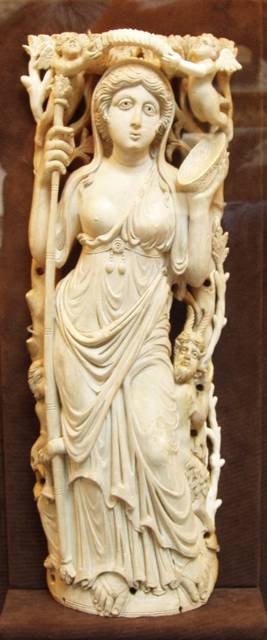
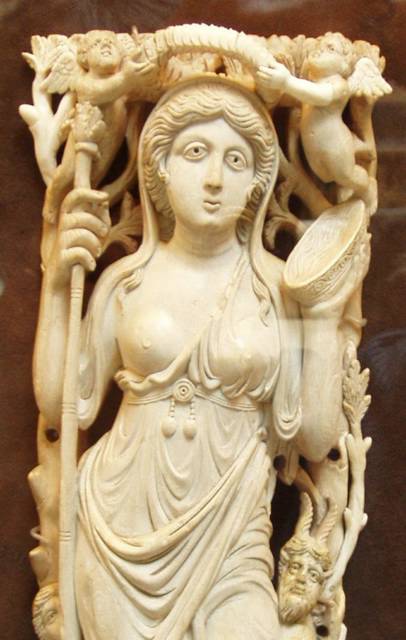
Detail of Ariadne, with satyr and winged cupids, from Constantinople, 6th Century. Ivory miniature (about 5" tall), Museum of Middle Ages, Paris. This beautiful little miniature is fascinating for its sad expression and mixture of Byzantine and classical elements. So is this Ariadne AFTER she's abandoned by Theseus? Note she's holding a staff (symbol of power or healing?) and a bowl (allusion to water?), with one breast exposed (reference to Amazons?). Many miniatures of this period and place (Constantinople) were of the Christ or religous themes, but here we find a classical theme, retelling the famous story of Ariadne, the woman who told Theseus how to find his way through the labyrinth, following her thread. His mission: to kill the dreaded Minotaur, ending the annual sacrifice of 7 pairs of maidens and young men, tribute from Athens to Knossos, also marking the shift of political power from the island of Crete to Greece.
Today is a quiet day, with many papers to read. Tomorrow we talk about Mesoamerican culture in humanities; perhaps that's the connection for we always wind up talking about human sacrifice. Time for tea. Beth
Tuesday, January 18, 2005
 ROMAN BATHS, BATH, ENGLAND. No one's allowed to go bathing now in these Roman baths, used for many hundreds of years by priests, royalty, and later, the aristocracy. When Rome pulled out, the baths were taken over by the locals and preserved. What amused me most were the many offerings to the gods made here, so that bathing was much more spiritual than today. And curses! "A plague be visited on the foul unmentionable one who took my toga!" These curses were etched on tiny tin or copper scrolls and then tossed into the pools as an offering to the goddess, along with coins. And, in an inner room, a large pool completely enclosed was reserved for the priests and for healing. A niche held a statue of the goddess.
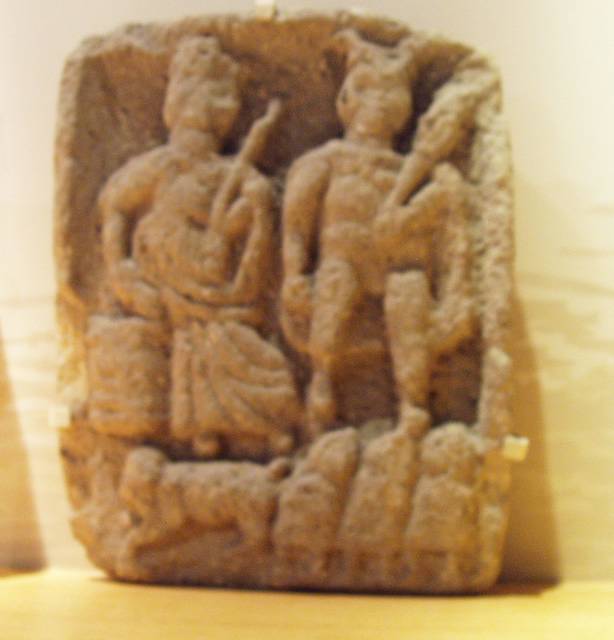
ARTIFACT OF THE DAY: Roman god Mercury with Celtic consort Rosmerta and 3 hooded deities. I know this is a rotten picture, but it's truly fascinating for its mix of ideas and cultures.
This sculpture (currently in the Musuem of the Roman Baths, in Bath, England) is badly worn, details of expression long gone. Rosmerta was known for her healing power; here she sits on a throne equally with Mercury, and carries a healing wand. In Britain, with Mercury, she is part of a divine couple (fused female and male divinity, rather different from the Christian hierarchy). She also sometimes appears with a cornucopia, a scroll, or a bucket (as here), or close to sacred waters.
Equally interesting are those three hooded figures at the bottom of the picture, called genii cucullati and shown with a mysterious animal. Some trace these three women (how can we tell they're women as this sculpture is so worn, but apparently, those short, heavy cloaks are icons themselves) back to the three aspects of mother goddess, worshipped widely during pagan times during the Winter Solstice (now Christmas), symbolizing abundance -- or perhaps abundance in womanly-ways -- wealth, wisdom, fertility, and healing as well. The animal lends a somewhat sinister air to modern eyes -- perhaps a familiar (too large?) or a lion/dog (symbol of the wild)? One essay links Roman, Celtic and Germanic traditions in the "Bethen", a female trio later transformed to saints under Christianity -- all marytred, all beheaded, all protectors of girls and women in some aspect of birth, fertility and death. All in all, a long way from home, yet the artifacts remain.
Additional sources: http://www.druidry.org/obod/deities/bavarian_triple_goddess.html
and http://www.unc.edu/~css/start.html and http://enchantedtempleofisis.com/roman.htm)
Saturday, January 08, 2005

Hathor column, Deir el-Bahri, Hatshepsut's Tomb. ARTIFACT OF THE DAY.
Hatshepsut's statues could be torn down, her prayers effaced, but the tomb remains, monumental, of stone, and enduring. She lived nearly 4,000 years ago, and ruled as the first female Pharoah for nearly 20 years, first as regent for the young Tuthmosis III, and then on her own. The picture shows columns still standing in a small temple dedicated to Hathor on the left side of the tomb. Other reliefs throughout the tomb show Hatshepsut's accomplishments; she negotiated and fought battles with Nubians, and a monumental frieze documents her expedition to the ancient city-state of Punt (today, Somalia), showing marvelous sea creatures, boats, gifts and giant mounds of incense. The frieze is now very difficult to see, colors worn away by sun and wind. An authorized copy was made of this very large frieze; the museum copy is now sharply incised and more brilliantly painted than the original.
Every image I brought back from sabbatical has a different story. If I listen just to the guides and read the printed materials available at site, I get one level. If after coming home, I look at popular articles, I get another level. And if I have good research materials, I get a third level. Hatshepsut is a case in point. We were told on site that the pharoahs after Hatshepsut destroyed and defaced her statues, and worked to erase her name from the list of pharoahs and from all memory because they didn't want to record a female pharoah. The next level of research reveals that indeed, she reigned as pharoah, regent and king for nearly 20 years, but popular stories affirm she was a peaceful ruler (being a woman, of course). The next layer of research reveals that she went on at least two military expeditions as well as the fabled expedition to Punt. And that other women ruled as "kings" and pharoahs of Egypt.
Hathor is typically shown with a female face, full hair, and cow's ears. I like to say Hathor's the original cow girl, but her identities were many and her power was recognized everywhere -- even to Abu Simbel. Hathor, a sky and cow goddess, was considered the Mistress of the West (traditionally the land of the dead, the direction of the dying sun), and placed near tombs or shown offering the ankh, the symbol of life to the pharoah, at once protecting and nurturing the ka or soul of the departed. Many offerings would be brought to Hathor during the Beautiful Feast of the Valley in a magnificent procession. So, Hathor brought hope at the moment of death. I think I'm fascinated by her because Hathor is decidedly female; she looks like someone we might know -- if we could set aside her ears.
Subscribe to:
Posts (Atom)