Monday, June 09, 2014

A little horse sense . . .

Early May we spent down in eastern Oregon, visiting friends at Eagle Crest for a blissful week of hiking in this high desert country. On one of our walks, we came across a paddock of horses and watched them for awhile. They watched us as well.


On this hot afternoon, the horses were taking turns before they drank deep at a single barrel filled with water on one edge of the field. They seemed to wait for permission from one alpha horse before they dipped their delicate noses into the barrel.


The strong and fattest horses ate first, using nickers and nudges to keep the scrawny horses from getting too close to the bundle of hay spread in the field.


I had never seen horses interacting like this in groups before. Maybe this is part of Darwin's "survival of the fittest," to not waste food on the weak. Or the influence of the environment, this dry, dry land. We sedentary city folk are only a few generations away from living this close to the land, when taking care of animals like these meant survival. 

Any horse stories to share?

Note: Click on any image to see it a little bigger.


Thursday, May 29, 2014

Around Longwood Gardens . . .

On a warm and not too humid sunny day, we set off for Longwood Gardens, about a 30 minute drive from Philadelphia. We spent the afternoon (and wished we had more time), first wandering through a few of the 20 outdoor gardens in this over 1,000 acre complex . . . 

Longwood Gardens (Camp 2014)

Then to the Wisteria garden . . . 

Wisteria Garden, Longwood (Camp 2014)


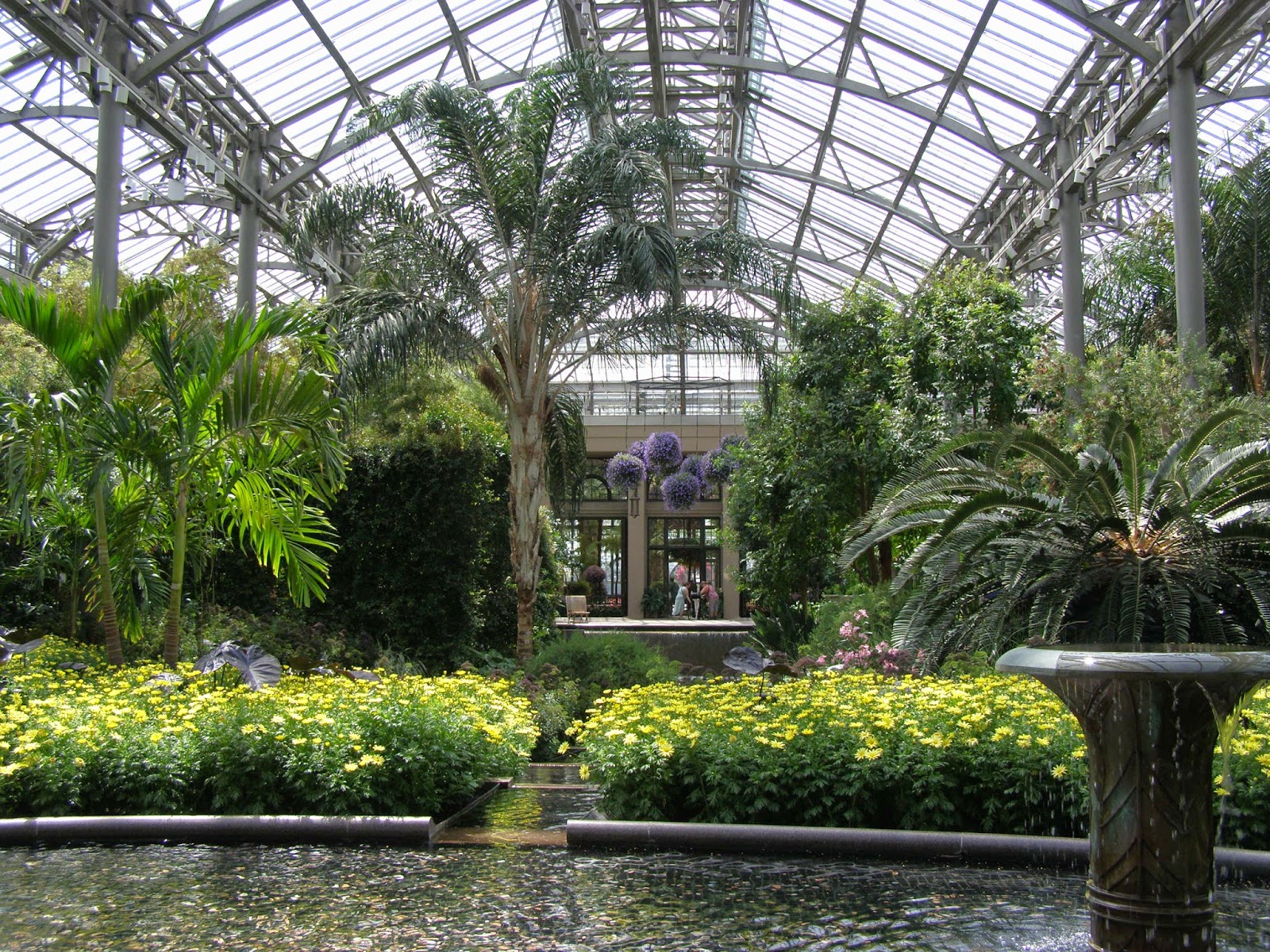
On to the Conservatories, an additional 20 inside gardens . . . 

Pools of water at Longwood (Camp 2014)

These are called Tower of Jewels (Camp 2014)
Everywhere we looked, we saw these stately, formal gardens with a profusion of flowers, shrubs, and trees. I cannot imagine living in such a place, surrounded by old wealth and riches. And yet, DuPont made these gardens available to the public and included funding so this gift would be permanently accessible. 

Despite the numbers of people visiting here each day, we found many spots to simply appreciate the beauty of the plantings. From large to small, all these gardens are inspirational. I hope the folks who lived here originally found comfort here.

From the desert gardens, a close-up of Neoregelia: 

To see more pics of this memorable trip to Longwood Gardens, go HERE.

Tuesday, May 27, 2014

On the road in 1850 . . .

I'm reading The Overland Journals of William and Charles Frush this week as background for my next book.

William Frush begins his journal with this cryptic entry dated May 15, 1850: "Left my family and home near Newark, Knox County, Missouri for California on one horse with the expectation of overtaking on route my brother with teem, John H. Frush."

The following entries are peppered with detailed road descriptions for those who might follow. Frush doesn't mention his brother again, but he continued west with a 40 pound pack, joining up with small groups, sometimes folks on horseback, sometimes wagon trains. He notes good meals, an occasional fight, Indians encountered, and graves spotted. Occasionally he sends letters home.

By December 14, he reaches Portland in Oregon Territory and settles there. Between the lines, I read great perseverance and admire his sheer stamina as well as his gift for understatement.

Frush consistently camps upstream from popular stopping places, perhaps because the water near popular camping spots was a source of dysentery and cholera -- two killers along the trail. 

On reaching the River Platte, After leaving Fort Laramie, conditions for those traveling in wagons worsened. Emigrants cut their wagons down or burned them. Grass was poor, and the trail ahead littered with dead stock and graves. Frush reports one man died of "the colera," leaving behind a wife and 7 children. What must it have been like for such a woman?

From the Missouri River to Oregon is roughly 2,000 miles. Frush made this journey in 8 months. 


The first Fort Laramie as it looked prior to 1840. Painting from memory by Alfred Jacob Miller
Source: Wikipedia


Tuesday, April 01, 2014

Mexico: Of Sacred Trees and Voladores

You may already be familiar with Mexico's beautiful "Tree of Life" pottery sculptures.
Clay sculptures have been a long tradition in MesoAmerica. Before the Conquest, the tree of life (or 'world tree') held deep significance for MesoAmerica, even though after the Conquest, these pottery sculptures became a key way to teach Christianity. I remember reading how the elders cried when the conquistadores burned religious books (codices), sculptures, and paintings.

In San Miguel de Allende, I learned the natives were put to work painting artwork for the Catholic Church in a small, nearby community. But the final murals were whitewashed and hidden from view for decades because they included what the church fathers deemed pagan images.

But the people remembered, and religious ideas were shared between native communities all through the Southwest and into South America.

Back in 2005, we visited Teotihuacan near Mexico City and stumbled upon a re-enactment of the ritual of the World Tree. I cannot pretend to understand its meaning, but to watch this ritual unfolding was a breathtaking experience.

First, somehow, a large artificial 'tree' had been erected.


Next, an elder ascended to the top of the tree, a flute in his hand. 


Four young men -- one for each sacred direction -- followed him up the tree. They are called voleadores (those who fly), though I have learned since a few women serve this role today.


The five balanced on top of the 'tree' as the elder played music and danced. He faced each of the dancers, perhaps to  honor the four sacred directions.  


Then, at a key moment, the four men reached out and fell, 
slowly circling the tree -- until they safely reached ground. 
What a moment of faith and trust.


I was so thrilled to see this for myself, that I tried to take a video, but my camera was sideways, and the video unusable. So I offer these few photographs I took that you may appreciate the beauty of this moment.

Today, this ritual of the voladores has been named an Intangible World Heritage by UNESCO.  More can be read at Wikipedia 


Saturday, March 08, 2014

Some sense of Salisbury . . . England!

We were at the end of our travels, scheduled for a month in England, and grateful for a rest in London. Five days at the British Museum, two days at the Library, before traveling to Salisbury for that obligatory stop at Stonehenge, a World Heritage site.

Stonehenge (Camp 2004)
What surprised me about Stonehenge was not the crowds of people, nor the ropes that prevented us from reaching out to touch these ancient stones, some 4,000 years old. It was seeing for myself what a picture could not communicate. The scale of the individual stones was simply massive. For example, just one of these stones, perhaps a lintel, measures 16 feet high by 6 feet wide.

The rolling hills around seemed innocent of any rocks like these. Academics have argued for generations about how these rocks came to be in this place. Wikipedia has an interesting overview of the site that describes how Stonehenge was used first as a burial mound and how it gradually morphed into some kind of gathering place, perhaps sacred, perhaps a healing place.

In Salisbury proper, we visited St. Thomas Church primarily to see its "doom" painting (a painting of the Last Judgment dating from about 1475), which clearly shows on each lower side those souls ascending to heaven or those descending to Hell's mouth. The story goes that this wonderful painting was created as a thank-offering for a safe return from the Holy Land, then whitewashed over during the Reformation and not rediscovered until the 19th Century.

Doom Painting at St. Thomas Church (Camp 2004)

Later, we walked over the more famous Cathedral of Salisbury, a much grander church built about 1220 (and home of one of the copies of the Magna Carta), but still, we strolled in the garden and tried to imagine a life of quiet contemplation. 

Cloisters,  Salisbury Cathedral, England (Camp 2004).
In the next few posts, I shall share images from several different trips as my computer can finally "read" picture CDs. May you travel well!

Wednesday, February 19, 2014

On the Serengheti . . .

Africa surprised me with its open spaces. Once we were on the Serengheti Plains, animals wandered about their lives, seemingly unaware of the rumbling, open-air tourist jeeps that parked nearby.

A lioness makes her way down a rocky hill on her way to find breakfast.while a herd of antelope grazes nervously thirty feet away. 

Looking for breakfast (Camp 2012)

Two giraffes amble on hilly ground, munching on the tops of thorny trees.

A landscape of giraffes (Camp 2012)

Herds of wildebeest cross in front of our jeeps by the thousands on their annual migration.

The Great Migration (Camp 2012)

Early one morning, we surprised a mother lioness and her babes at a watering hole.

At the watering hole (Camp 2012)


 And at the end of the day, the African landscape shimmers at sunset. Beautiful memories!

Camping near Serengheti Plains (Camp 2012)


Friday, February 14, 2014

Friday: Do It Different Day!

Friday. We planned a scrumptious lunch of sushi to celebrate Valentine's Day after the morning mix of snow and rain slowed. But I went out to the garage to go for a morning swim at a gym nearby. The car would not respond. Not a click. Not a moan.

Thankfully, the AAA guy was here in under 30 minutes to diagnose a dead starter. He pounded on the starter with a big hammer, and our little Toyota sprang to life! So we drove to our car repair place here in Spokane and are now home, waiting for news.

Today is definitely "do it different" day!

Instead of leaping into the projects that await my attention, I wanted to post here, the first entry since January 3. What stops me from posting more often here? We're not really on the road these days, though we have two trips coming up this year that I'm excited about -- one to Oregon this spring and the other to Canada late in the summer. But day-to-day, we're home in Spokane. I thought you might enjoy reading about past trips, but posting here seems to fall to the bottom of the list.

How about random pictures from travels? What do you think?

Here's are are two leopards taking a little siesta before bounding out to hunt. Perhaps these are appropriate for today -- Happy Valentine's Day!

Nuzzling Leopards on the Serengheti (Camp 2012)

Getting Close on Valentine's? (Camp)