Saturday, October 01, 2005


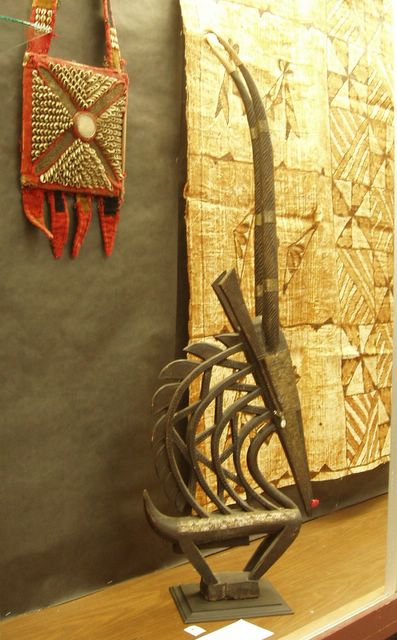
Detail of Chiwara Mask from Bambara of Mali, Africa. The first time I saw a chiwara mask was in the video, African Art, which had just a small clip of people in a small village talking about the importance of this ritual dance, done just before planting. The dance/ritual commemorated how the Bambara learned how to till the ground with a tool rather than by hand, probably adapted from the antelope's horns. The video vividly shows the mask in context, costume, drum, music, and that thin line between forest and field. But a photograph can never capture the artifact itself -- which Gary Westford has made more accessible to us by creating the library display at LBCC. Very few of us can ever hope to see the chiwara mask as it was meant to be experienced, at the center of ritual.

This impressive mask is about 3 feet tall, with intricate carvings. Some sources report that only men dance with the chiwara mask; however, the masks themselves answer this question as we can see two styles of chiwara -- male and female. Gary's mask (above) shows a male mask; the woman's mask inclues a baby antelope; she symbolizes the earth, the baby symbolizes humankind.

The costume in the African Art video is made of raffia (a kind of straw), and Parrinder (see below) shows a mask with black and white cloth decorated with symbols of the universe. The ritual itself is to ensure fertility -- of the crops and of the community, much like the underlying roots to our own Passover or Easter for spring planting, and then in the fall, somewhat like Succot or Thanksgiving for harvest.Posted by Picasa

Chiwara Mask from Bambara of Mali, Africa, Gary Westford exhibit, Linn-Benton Community College Library, Albany, Oregon. Posted by Picasa

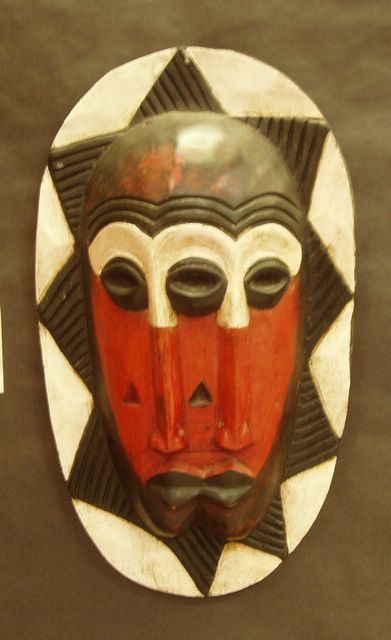
Wedding Portrait Mask, Ghana, Africa. Gary Westford at LBCC put together an amazing exhibit of African artifacts at our main campus library, including this wonderful mask that shows two faces coming together as one. I don't know more about this mask, but I'm fascinated by the double image for in Benin (also in Southwest Africa), traditional stories about sacred or heavenly twins are common, originally from creation stories. Could this mask be actually a mask of twins but sold to tourists as a "wedding portrait mask"? My question comes because usually masks show gender -- and here the gender is subsumed. That could be reinforcing the melding of two to one in a marriage. So, more research is needed.

Geoffrey Parrinder talks about the primeval twins who were the parents of all other gods. Their first act was to create 7 pairs of twins (for example, the twins of Storm), all to rule different aspects of the earth, a neat turn on animism (page 23) in African Mythology (New York: Barnes & Noble 1996). Posted by Picasa

Wednesday, August 03, 2005

No way to post pictures, but this morning I´m writing from a little internet cafe in San Miguel de Allende in Gto., Mexico. The door is open to let a few fresh breezes in, and the taxis, cars of every description, including the infamous SUV, trucks, busses, and the occasional dune buggy, all pass by, bumping over historic cobblestone streets. San Miguel is still unforgettably lovely. We were first here over 30 years ago and the city has grown much. The biblioteca is still the biggest English language library in all of Mexico, although the collection is very dated. Literacy programs and scholarships for Mexican children are the main focus. Retirees clog the downtown area, and the artisan's market is still filled with colorful and beautiful Mexican crafts, more expensive than I ever imagined. What I will remember most are the rooftop gardens with sweeping vistas, and houses with bouganville cascading down their sides, incredibly fresh mangos, bananas, and avacados, and patient people who speak Spanish slowly. Each morning, the birds -- including a lovely white egret -- flock from Benito Juarez part, just two blocks from our little apartment, and the writing goes well. Beth

Saturday, June 11, 2005


Roman mosaic found in Turkey telling story of the birth of the Minotaur and Daedalus' design of the labyrinth. The interesting story of this mosaic is that NOVA writes it up with an emphasis on Daedalus and Icarus, even to the title of this mosaic. Here's NOVA's summary.

"When King Minos of Crete [center] decided to keep alive a magnificent bull that Poseidon had given him for sacrifice, the sea god punished him by having Minos's wife Pasiphae (seated at left in the mosaic) fall in love with the bull. To satisfy her desire, the architect Daedalus and his son Icarus (second from right and far right, respectively) built her a hollow cow in which she could hide and mate with the bull. Their coupling produced the half-man, half-bull Minotaur, which was shut away in the maze-like Labyrinth (upper right)."

The female figure between King Minos and Pasiphae remains a mystery. The central figure remains King Minos, linked to his wife on the left, yet reaching out to Daedalus on the right. Pasiphae is shown seated, looking somewhat self-satisfied, self-absorbed. Researchers speculate that the laybrinth, shown on the far right as a separate building, is actually the entire palace complex at Minos on Knossos for its hundreds of connecting rooms and hallways. What is the moral of this story: To disobey the gods brings horrific retribution? That our desires or curiosity cannot always be satisfied? That we cannot always confront what we create -- with human technology? How interesting that this particular scene, massive in size, was chosen for the floor of this Roman villa in Turkey. Which characters shown drawn your sympathy? I'm curious about that woman in the middle. Is she a servant? A messenger? A goddess herself? Is she perhaps the storyteller herself (see the outstretched hand), or is she the mistress of the house in which this mosaic was found?

Source of story and mosaic: http://www.pbs.org/wgbh/nova/zeugma/mosa_05.html#fea_top Posted by Hello
Saturday morning, early. Spring term is finally over! Whew! What a rush at the end with last-minute papers, a mix of celebration and completion for most. This morning up far too early but Allen called me in to see a few minutes of NOVA's breathtaking story about the Roman mosaics found in Turkey. 10 mosaics were discovered just before (or perhaps because of) a new dam that would drench this historic area with a new lake. The expressiveness of these mosaics, the brilliance of their colors -- and the really fine recreation of a Roman villa in the Hellenistic period make this site one to visit: http://www.pbs.org/wgbh/nova/zeugma/
And now that summer's begun, it's time to blog once more. So, into the breach, blog!

Sunday, May 15, 2005


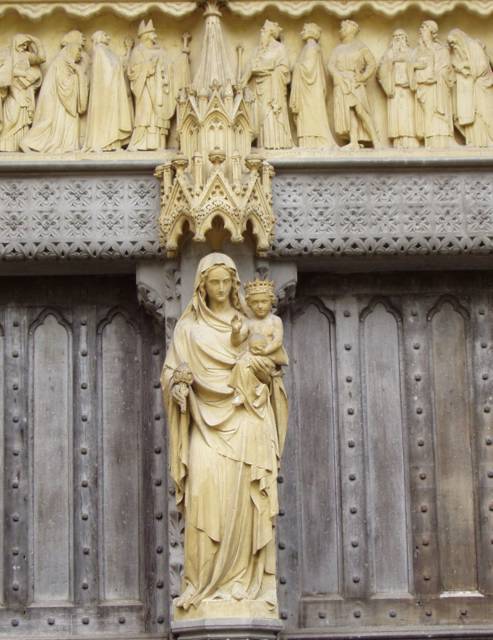
Virgin with Christ child and Jerusalem crown, Westminster Abbey, London, July 2004. Posted by Hello On Friday, in a rather large and impersonal classroom, I gave the slide-show on Israel at school. I was concerned before hand and felt even after, the overall talk didn't say everything I wanted. So here's a place to put the ideas down. Part of the problem is that religion is involved. Who could consider traveling to Israel and not be drawn to the topic of religion and Jerusalem? So, writing my ideas down will help me crystalize my thinking -- even if there's no time, not enough time for this kind of writing.

Why begin with a sculpture outside Westminster Abbey in London, when I want to talk about Jerusalem? The statue is conventional and beautiful, with a curious city floating above her head. I found this city-crown floating over hundreds of church sculptures -- saints and the virgin. Finally, in an orientation by a man who studied church architecture his entire life, finally, at Chartres Cathedral, in France, I learned the mystery behind these curious city-crowns. They represent Jerusalem and the longing of the Christian medieval world to reclaim the birthplace of Jesus from the Muslims.

For at this time, just after the turning of the millenium, powerful religious, economic and political factors fused to bring the Western Christian world in a series of brutal Crusades against the Muslim world, which at that time dominated the lands around the Mediterranean Sea, from eastern Turkey, through Palestine, Egypt, across northern Africa and up to well over half of Spain. People from every class joined the Crusades over a 200 year period, in five separate waves, the First Crusade called by Pope Innocent III, not to convert lost souls to Christianity, but to reclaim the heart of Christianity -- Jerusalem.

We cannot understand Jerusalem and the current state of Israel without understanding the history of enmity that permeates her culture.

My talk explored the story of Masada, and then returned to Jerusalem to look at three sacred spots: the Wailing Wall, sacred to Jews as a tangible reminder and place to mourn the loss of the Second Temple, which was destroyed in the year 70, and itself represented the rebuilding of King Solomon's First Temple that held the Ark of the Covenant; the Church of the Holy Sepulchure, built originally by St. Helena, sister to Emperor Constantine, in 345, and sacred to Christians as the church that marks the crucifixion of Christ (five Stations of the Cross are placed inside this church); and the Dome of the Rock, sacred to Muslims, for that golden-domed mosque built in 691 was placed where Mohammed left for his Night Journey, his footprint embedded in the Foundation Stone which rests at the center of the mosque. And yet enmity and the potential for violence permeate the culture of Jerusalem, despite the confluence of these three major religions.

Part 1 (next time) Masada. Please leave a comment if you like; I think they're working now. Beth